Quadratics
Recognising quadratic relationships, graphing parabolas and their transformations, the three forms of a quadratic, and solving quadratic equations with graphs, square roots and factorising.
Downloads
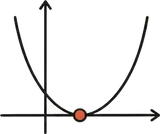
A quadratic is a relationship with a squared term, like $y = x^2 - 4x + 3$. Its graph is a smooth U-shaped curve called a parabola, the same shape as the path of a thrown ball or the jet of a fountain. In the Algebra topic you learned to expand and factorise expressions like $x^2 + 7x + 12$. In this topic you'll use those skills to draw and transform parabolas, read their key features, and solve quadratic equations with graphs, square roots and factorising.
What you'll learn
- 5.01 Quadratic relationships: recognising quadratics in equations, tables and graphs, and using second differences.
- 5.02 Graphs and features of quadratics: the turning point, axis of symmetry, intercepts and concavity of a parabola.
- Investigation: transformations of quadratics. Use graphing software to see what each number in $y = a(x - h)^2 + k$ does to the graph.
- 5.03 Basic quadratics: graphs of $y = ax^2$, and how $a$ stretches or flips the parabola.
- 5.04 Vertical translations: moving parabolas up and down with $y = ax^2 + k$.
- 5.05 Horizontal translations: moving parabolas left and right with $y = a(x - h)^2$.
- 5.06 Turning point form: reading, sketching and writing equations like $y = 2(x - 3)^2 + 1$.
- 5.07 Factorised form: using $y = a(x - p)(x - q)$ to find the intercepts and turning point.
- 5.08 Standard form: working with $y = ax^2 + bx + c$ and changing between the three forms.
- 5.09 Solutions to quadratics: solving quadratic equations with graphs, tables and technology.
- 5.10 Solve algebraically: solving equations like $(x - 2)^2 = 9$ by taking square roots.
- 5.11 Solve by factorisation: solving equations like $x^2 - 5x + 6 = 0$ with the null factor law, and using them in real problems.
- Investigation: other non-linear graphs. Explore hyperbolas, exponentials and circles, and compare them with parabolas.
Which level should I pick?
Every worksheet comes in three levels. Each one covers the same skills.
- Level 1 · Warm-up: simpler equations and more help along the way. A good place to start.
- Level 2 · Core: the main worksheet for the lesson.
- Level 3 · Challenge: fractions, surds and problems with more steps, for when the Core level feels easy.
Not sure? Start with Level 2. If the first few questions feel tricky, drop to Level 1. If you finish quickly and get them right, try Level 3. Download the worksheet, print it, and write your answers in the boxes.
Practice tests
When you've finished the lessons, try the three practice tests. Each one is like the real topic test: 45 minutes, 40 marks, a section without a calculator and a section with one. Write your working under each question, then copy your final answers onto the answer sheet on the last page, just like you will in the real test.
Curriculum outcomes
What this topic covers in the Australian Curriculum (version 9).
identify and graph quadratic functions, solve quadratic equations graphically and numerically, and solve monic quadratic equations with integer roots algebraically, using graphing software and digital tools as appropriate
use mathematical modelling to solve applied problems involving change including financial contexts; formulate problems, choosing to use either linear or quadratic functions; interpret solutions in terms of the situation; evaluate the model and report methods and findings
experiment with the effects of the variation of parameters on graphs of related functions, using digital tools, making connections between graphical and algebraic representations, and generalising emerging patterns
Outcomes lesson by lesson
- 5.01 Quadratic relationshipsAC9M9A04
- 5.02 Graphs and features of quadraticsAC9M9A04AC9M9A06
- Investigation: Transformations of quadraticsAC9M9A06
- 5.03 Basic quadraticsAC9M9A06
- 5.04 Vertical translationsAC9M9A06
- 5.05 Horizontal translationsAC9M9A06
- 5.06 Turning point formAC9M9A04AC9M9A05
- 5.07 Factorised formAC9M9A04AC9M9A05
- 5.08 Standard formAC9M9A04AC9M9A05
- 5.09 Solutions to quadraticsAC9M9A04AC9M9A05
- 5.10 Solve algebraicallyAC9M9A04AC9M9A05
- 5.11 Solve by factorisationAC9M9A04AC9M9A05
- Investigation: Other non-linear graphsAC9M9A06