Pythagoras' theorem
Squares and square roots, a proof of Pythagoras' theorem, finding the hypotenuse and the shorter sides of right-angled triangles, and using the theorem to solve real problems.
Downloads
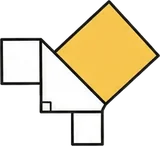
A right-angled triangle has a remarkable rule hidden inside it: the square on the longest side is exactly as big as the squares on the other two sides added together. This rule, Pythagoras' theorem, has been used for thousands of years to build square corners, measure distances and design roofs. In this topic you'll revise squares and square roots, prove the theorem for yourself, and use it to find missing sides and solve real problems.
What you'll learn
- 8.01 Squares and square roots: a refresher on squares, square roots and estimating square roots that are not whole numbers.
- Investigation: proof of Pythagoras' theorem. Count squares on a grid, then cut out four triangles and rearrange them to see why the rule always works.
- 8.02 Pythagoras' theorem: the hypotenuse, the rule $c^2 = a^2 + b^2$, testing whether a triangle is right-angled, and exact lengths like $\sqrt{2}$.
- 8.03 Find the hypotenuse: using the theorem to find the longest side of a right-angled triangle.
- 8.04 Find a short side: rearranging the theorem to find one of the two shorter sides.
- 8.05 Applications of Pythagoras' theorem: ladders, ramps, screens, journeys and shapes, solved with the theorem.
Which level should I pick?
Every worksheet comes in three levels. Each one covers the same skills.
- Level 1 · Warm-up: smaller numbers and more help along the way. A good place to start.
- Level 2 · Core: the main worksheet for the lesson.
- Level 3 · Challenge: harder numbers and multi-step problems, for when the Core level feels easy.
Not sure? Start with Level 2. If the first few questions feel tricky, drop to Level 1. If you finish quickly and get them right, try Level 3. Download the worksheet, print it, and write your answers in the boxes.
Practice tests
When you've finished the lessons, try the three practice tests. Each one is like the real topic test: 45 minutes, 40 marks, a section without a calculator and a section with one. Write your working under each question, then copy your final answers onto the answer sheet on the last page, just like you will in the real test.
Curriculum outcomes
What this topic covers in the Australian Curriculum (version 9).
recognise irrational numbers in applied contexts, including square roots and π
use Pythagoras’ theorem to solve problems involving the side lengths of right-angled triangles
From earlier years: these lessons revise skills students learnt in earlier years that this year's curriculum builds on, so they aren't linked to an outcome code for this year.
Outcomes lesson by lesson
- 8.01 Squares and square rootsFrom earlier years
- Investigation: Proof of Pythagoras' theoremAC9M8M06
- 8.02 Pythagoras' theoremAC9M8N01AC9M8M06
- 8.03 Find the hypotenuseAC9M8M06
- 8.04 Find a short sideAC9M8M06
- 8.05 Applications of Pythagoras' theoremAC9M8M06